What Do Loons Look Like?
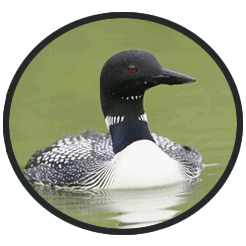
Loons are large waterbirds with striking black-and-white patterns! Common loons have jet-black heads with a green sheen in summer. Their backs are covered in bold black-and-white checkerboard patterns. A striped black-and-white collar wraps around their necks. Their bellies are bright white. In winter, loons turn plain gray-brown on top and white below!
Loons have bright red eyes that look very dramatic! Scientists think the red color may help loons see underwater. Their bills are long, straight, and dagger-like-perfect for catching fish. Loons have thick, heavy bodies built for diving. Their legs are set far back on their bodies. This placement makes them powerful swimmers but clumsy on land!
There are five species of loons in the world! The common loon is the most familiar in North America. Red-throated loons have a reddish patch on their throats. Pacific loons live along western coastlines. Arctic loons breed in northern Europe and Asia. Yellow-billed loons are the largest species with pale yellow bills. All loons share the same streamlined body designed for underwater hunting!
Where Do Loons Live?
Loons breed on quiet lakes across Canada, the northern United States, and northern Europe! They prefer clear lakes with plenty of fish. Common loons need large lakes with enough space for their long take-off runs. They build nests right at the water's edge, often on small islands. Loons are very territorial and usually only one pair lives on each lake!
In winter, loons migrate to ocean coastlines! They fly south to spend cold months along the Atlantic, Pacific, and Gulf coasts. Loons can also be found on large reservoirs and bays during migration. They travel hundreds or thousands of miles between their summer lakes and winter ocean homes. Some loons winter as far south as Mexico!
Loons need very clean water to survive! They depend on clear lakes where they can see fish underwater. Pollution, acid rain, and shoreline development all threaten loon habitat. Lead fishing weights are especially dangerous because loons swallow them by mistake. Many conservation groups work to protect loon lakes and keep the water clean!
What Do Loons Eat?
Loons eat mostly fish! They catch perch, sunfish, trout, minnows, and many other species. A loon hunts by swimming on the surface and dipping its head underwater to spot prey. When it sees a fish, the loon dives and chases it. Loons catch fish by grabbing them with their sharp bills. They swallow small fish whole while still underwater!
Loons are incredible underwater hunters! They can dive deeper than 200 feet and stay underwater for up to 5 minutes. Most fishing dives last about 40 seconds. Loons chase fish with powerful kicks from their webbed feet. They can change direction quickly underwater. A loon may catch several fish during a single feeding session!
Loons also eat crayfish, frogs, leeches, and aquatic insects! Baby loons start by eating tiny insects and small minnows. Parents catch food and bring it to the chicks on the surface. As chicks grow, they learn to dive and catch their own fish. Young loons practice diving for weeks before they become skilled hunters like their parents!
Baby Loon Facts
Loon parents build a simple nest of plants right at the water's edge! The nest is usually on a small island or a sheltered shoreline. Mother loons lay 1 to 2 large, olive-brown eggs. Both parents take turns sitting on the eggs for about 28 days. Loon parents are very protective of their nest and will dive and splash to scare away intruders!
Baby loons are covered in dark, fluffy down when they hatch! They can swim within hours of hatching. Chicks leave the nest on their first day and head straight to the water. They're already good swimmers but tire quickly. That's why baby loons ride on their parents' backs during the first couple of weeks!
Loon chicks grow fast on a diet of small fish and insects! Parents catch tiny minnows and offer them to the chicks on the water surface. As chicks grow, they start diving on their own. At first, they can only stay under for a few seconds. By 8 weeks old, chicks are catching some of their own food. They practice diving over and over!
Young loons stay with their parents for about 12 weeks! By then, they can fly and hunt on their own. The parents usually leave the lake first, heading to the coast for winter. The young loons follow later. Young loons don't return to breeding lakes for 2 to 3 years. They spend those years on the ocean, growing and getting strong. Loons can live 20 to 30 years!
Why Are Loons Special?
Loons are symbols of wilderness and wild places! Their haunting calls represent peaceful northern lakes. The common loon appears on the Canadian dollar coin, which is called the "loonie." Many people travel to northern lakes just to hear loons calling. These birds connect us to wild, unspoiled nature!
Loons are remarkable diving birds designed for underwater hunting! They can see, swim, and catch fish at depths that would amaze most people. Their ability to live on both freshwater lakes and ocean waters shows great flexibility. Loons spend nearly their whole lives on or in the water. They're true water birds in every way!
Loon populations face several challenges today! Mercury pollution in lakes affects their health. Lead fishing tackle poisons loons that swallow it. Boat traffic disturbs nesting loons. Rising water levels can flood nests. Conservation groups put up floating nest platforms, ban lead tackle on loon lakes, and educate boaters to give loons space!
Loons remind us how important clean water is for wildlife! These birds need crystal-clear lakes to hunt and raise their families. When loons disappear from a lake, it often means the water quality has gotten worse. By protecting loons, we also protect the lakes and waterways that many other animals and people depend on. Loons are living signs of healthy waters!