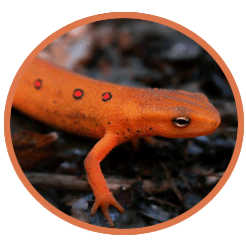
What Do Salamanders Look Like?
Salamanders have lizard-like bodies with four legs and long tails! But unlike lizards (which are reptiles), salamanders are amphibians with smooth, moist skin that must stay wet. This is a key difference!
Salamanders range from tiny to HUGE! The smallest is the Thorius salamander at only 1 inch long - it could sit on your thumb! The largest are Chinese and Japanese Giant Salamanders, which can grow 6 feet long and weigh 140 pounds - bigger than most adult humans!
Most salamanders have four legs! Their front legs have 4 toes, while back legs have 5 toes. Salamanders walk by moving legs on opposite sides - right front with left back, then left front with right back. This creates an S-shaped wiggle!
Salamander skin is special! It's smooth, moist, and permeable - allowing them to breathe through it! Many salamanders have poison glands in their skin that ooze toxins when threatened. Bright colors warn predators "Don't eat me, I'm poisonous!"
Salamanders come in amazing colors! Many are black, brown, or gray for camouflage. Others are bright yellow, orange, red, or have bold patterns. Fire Salamanders are black with yellow spots. Tiger Salamanders have yellow bars. Red Salamanders are bright red or orange!
Three main groups of salamanders exist:
- Newts - Spend more time in water, rougher skin, often brightly colored
- True Salamanders - Four legs, long tail, live near water or in moist forests
- Lungless Salamanders - No lungs! Breathe only through skin and mouth lining
Some salamanders keep juvenile features as adults! Axolotls and Mudpuppies keep their feathery external gills throughout life. Most salamanders lose gills as they mature, but these species never do! This is called neoteny.
Where Do Salamanders Live?
Salamanders are mostly found in the Northern Hemisphere! The highest diversity is in North America, especially the Appalachian Mountains. They're also found in Europe, Asia, and parts of South America.
Most salamanders need moisture! They live in or near water, in damp forests, under logs and rocks, or in caves. Their permeable skin means they lose moisture easily and must stay in humid environments.
Different salamanders prefer different habitats! Stream salamanders live in fast-flowing mountain streams. Woodland salamanders live in moist leaf litter on forest floors. Cave salamanders live deep underground in total darkness. Aquatic salamanders spend their entire lives in water!
Some salamanders are completely aquatic! Axolotls, Mudpuppies, and Sirens live permanently in water. They never come to land and keep their gills throughout life. Aquatic salamanders can be found in lakes, ponds, rivers, and streams.
Lungless salamanders are North America's specialty! Most salamander species in the USA are lungless. They breathe entirely through their skin and mouth lining. These salamanders must keep their skin constantly moist to absorb oxygen!
Many salamanders are nocturnal! They hide during the day under logs, rocks, or in burrows. At night, they emerge to hunt. Being active at night helps them avoid drying out in the sun.
Salamanders hibernate in winter! In cold climates, salamanders burrow underground or hide under deep leaf litter. They enter a dormant state, barely breathing or moving. In spring, they emerge and begin breeding!
Some salamanders migrate to breeding ponds! On rainy spring nights, hundreds of salamanders travel to traditional breeding ponds. These mass migrations can be spectacular, with salamanders covering roads and trails!
What Do Salamanders Eat?
Salamanders are carnivores - they only eat meat! They're predators that hunt small prey, mainly at night.
What's on a salamander's menu?
- Insects (beetles, flies, ants)
- Worms and slugs
- Spiders and mites
- Snails (they can digest shells)
- Small crustaceans (aquatic species)
- Small fish (large species)
- Other salamanders (large species)
Salamanders catch prey in different ways! Most use a sticky tongue to catch prey, similar to frogs. Aquatic salamanders open their mouths suddenly, creating suction that pulls prey in. This is called suction feeding!
Large salamanders eat surprising prey! Giant Salamanders can catch fish, frogs, crayfish, and even small mammals! Hellbenders (a type of large salamander) eat crayfish as their main food. Tiger Salamanders eat worms, insects, and even small mice!
Salamanders don't have teeth for chewing! They have small teeth for gripping prey. Once caught, prey is swallowed whole. The teeth just help hold struggling prey until it can be swallowed.
Many salamanders help control pests! By eating insects, slugs, and other invertebrates, salamanders provide natural pest control. A single salamander can eat hundreds of insects each year!
Salamanders can go long periods without food! In winter or during dry spells, salamanders eat very little or nothing at all. Their slow metabolism allows them to survive months without eating.
Larvae eat different food than adults! Young salamander larvae eat tiny aquatic organisms like zooplankton, small worms, and insect larvae. As they grow, they eat progressively larger prey.
Baby Salamanders
Baby salamanders are called larvae. How they develop depends on the species!
Most salamanders lay eggs in water! Females attach eggs to underwater plants, rocks, or logs. They lay 20-500 eggs depending on species. Some salamanders guard their eggs; others leave them to develop alone.
Salamander eggs hatch into larvae! Larvae look different from adults. They have feathery external gills for breathing underwater, fin-like tails, and often no legs at first. They're completely aquatic!
Larvae gradually metamorphose! Over weeks or months, larvae develop legs, lose their gills, and their tail fin becomes rounder. Lungs develop (if the species has lungs). Eventually, they transform into adult salamanders and leave the water - or stay in water if they're an aquatic species!
Some salamanders give live birth! A few species don't lay eggs. Instead, females keep eggs inside their bodies until they hatch. Babies are born as fully-formed miniature salamanders!
Some salamanders skip metamorphosis! Axolotls, Mudpuppies, and some other species keep their larval features throughout life. They can reproduce while still having gills and aquatic bodies!
Parental care is rare but fascinating! Some lungless salamanders guard their eggs and newly hatched young. Mothers coil around eggs to protect them from predators and keep them from drying out. This is unusual for amphibians!
Young salamanders grow slowly! It takes 1-3 years for most salamanders to reach adult size. Giant Salamanders take even longer - up to 10 years to reach full size! Salamanders can live a long time - some species live 25+ years!
Why Are Salamanders Special?
Salamanders are designed with remarkable adaptations! Their incredible regeneration abilities, diverse breathing methods (lungs, gills, skin), and ability to thrive in specialized habitats make them unique among vertebrates. They're living examples of amazing biological diversity!
Salamanders are environmental indicators! Because they breathe through permeable skin, salamanders are extremely sensitive to pollution. Declining salamander populations signal environmental problems. Healthy salamander populations mean healthy ecosystems!
Salamanders control forest insect populations! In forests where they're common, salamanders eat so many insects that they affect entire food webs. They're crucial for keeping insect populations balanced!
Many salamander species are threatened! Habitat loss, pollution, and disease threaten salamanders worldwide. Some species have gone extinct, and many are critically endangered. Over 50% of salamander species face some level of threat!
Conservation is crucial! Protecting clean water sources, preserving forests, and creating wildlife corridors help salamanders. Fighting the chytrid fungus (a deadly disease affecting amphibians) is also vital. Everyone can help by keeping waterways clean and protecting wild habitats!