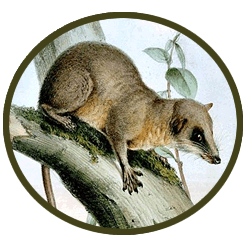
What Do Tree Shrews Look Like?
Tree shrews look a lot like small squirrels! They have soft, brown or reddish-brown fur with lighter bellies. Their bodies are slender and compact with long, bushy tails. Most tree shrews are about the size of a chipmunk. They have large eyes compared to their head size, which gives them excellent vision. Their pointed snouts and small ears give them a cute, alert appearance!
Tree shrews have sharp claws on all their toes that help them climb! Their fingers and toes are well-suited for gripping branches and tree bark. Unlike true shrews, tree shrews have good eyesight and rely on vision more than smell. Their front teeth are sharp and designed for biting into insects and fruit. Tree shrews have a long tongue they use to lick nectar from flowers!
There are about 20 species of tree shrews, and they come in different sizes! The pen-tailed tree shrew has a tail that looks like a feathered pen, with bare skin and a tuft at the tip. The common tree shrew is one of the most widespread species. The Philippine tree shrew is one of the largest. Despite their squirrel-like appearance, tree shrews are more closely related to primates than to any rodent!
Where Do Tree Shrews Live?
Tree shrews live in the tropical forests of Southeast Asia! They're found in countries like Malaysia, Indonesia, Thailand, the Philippines, and India. Most species live in lowland tropical rainforests. Some species live in mountain forests up to 10,000 feet elevation. Tree shrews are found nowhere else in the world-they're truly Asian mammals!
Despite their name, many tree shrews spend most of their time on the ground! While some species are excellent climbers, others prefer scurrying through leaf litter on the forest floor. The terrestrial tree shrew barely climbs at all. Other species split their time between the ground and low bushes. The pen-tailed tree shrew is the most tree-dwelling species, spending most of its time in the canopy!
Tree shrews are territorial animals! Each tree shrew marks its territory with scent from special glands on its belly and chest. Males and females have separate but overlapping territories. Tree shrews defend their space with loud squealing calls and chases. They patrol their territory daily, visiting the same feeding spots and scent-marking locations. A tree shrew's territory may cover about half an acre of forest!
What Do Tree Shrews Eat?
Tree shrews eat a mixed diet of insects, fruit, and other foods! They hunt for beetles, ants, spiders, and caterpillars in leaf litter and on tree bark. They also eat ripe fruit, seeds, and young leaves. Some tree shrews eat small lizards and other tiny animals. Their varied diet helps them find food throughout the year!
Tree shrews are always eating because they have incredibly fast metabolisms! Their bodies burn energy so quickly that they must eat frequently throughout the day. A tree shrew eats about half its body weight in food every single day. They start foraging at dawn and keep eating until dusk. If a tree shrew goes too long without food, it can actually starve very quickly!
The pen-tailed tree shrew has an unusual food source-fermented nectar! It regularly drinks naturally fermented palm nectar that contains alcohol. This tree shrew drinks the equivalent of several glasses of wine each night without getting drunk! Scientists believe its liver is specially designed to break down alcohol quickly. The pen-tailed tree shrew is the only mammal known to regularly consume alcohol in the wild!
Baby Tree Shrew Facts
Female tree shrews build special nursery nests for their babies! The nursery nest is separate from the mother's sleeping nest. It's lined with dry leaves and built in a safe, hidden spot. The mother constructs the nursery before giving birth. She may build it in a tree hollow, dense bush, or on the ground among roots!
Tree shrews give birth to 1 to 3 tiny, hairless babies! Newborns are blind, deaf, and completely helpless. They weigh less than half an ounce at birth. The babies huddle together in the nursery nest for warmth. They depend entirely on their mother's milk for survival in the first weeks!
Mother tree shrews produce incredibly rich milk! Their milk is among the most concentrated of any mammal. It's packed with fat and nutrients that sustain the babies between the mother's rare visits. In species where the mother visits only every 48 hours, the babies fill their tiny stomachs during a single short nursing session. This rich milk lets the babies grow even without constant attention!
Baby tree shrews grow up fast! Their eyes open at about 2 to 3 weeks old. They start exploring outside the nest at about 4 weeks. Young tree shrews begin eating solid food while still nursing. They're fully independent at about 5 to 6 weeks old. Young tree shrews must find their own territory quickly, as parents don't tolerate them staying too long!
Why Are Tree Shrews Special?
Tree shrews are fascinating little mammals! They share some features with primates, like forward-facing eyes, a large brain, and nimble bodies. Scientists find them interesting because studying them teaches us how many different kinds of mammals God designed!
Tree shrews are valuable for scientific research! Scientists study tree shrews to understand diseases, brain function, and mammal biology. Their biology is surprisingly similar to humans in many ways. Tree shrews can catch some of the same viruses that affect people. Their close relationship to primates makes them important for medical research!
Most tree shrew species are doing well, but habitat loss is a concern! As tropical forests in Southeast Asia are cut down for farming and development, tree shrews lose their homes. Species that live only on certain islands are more at risk. Protecting Southeast Asian rainforests is the best way to keep tree shrew populations healthy!
Tree shrews remind us that some of the most fascinating animals are ones most people have never heard of! These tiny, energetic mammals have the biggest brains for their size of any mammal. Every time a tree shrew darts through the forest with its keen eyes and quick feet, it shows off the clever design God gave it!