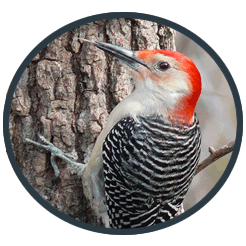
What Do Woodpeckers Look Like?
Woodpeckers have distinctive features suited for their tree-dwelling lifestyle! Strong beaks, stiff tail feathers, and zygodactyl feet (two toes forward, two back) make them perfect tree climbers!
Downy Woodpecker - Smallest North American Species:
- Only 6-7 inches long
- Black and white checkered pattern
- Small bill (shorter than head width)
- Males have red patch on back of head
- Common backyard visitor!
- Often feeds at suet feeders
Hairy Woodpecker - Downy's Larger Look-Alike:
- 9-10 inches long
- Almost identical to Downy but larger
- Large bill (as long as head width)
- Males have red head patch
- Prefers mature forests
- Louder calls than Downies
Pileated Woodpecker - Largest North American Woodpecker:
- 16-19 inches long - crow-sized!
- Dramatic red crest on head
- Black body with white stripes
- Large, chisel-like bill
- Rectangular holes in trees (signature!)
- Loud, jungle-like calls
- Shy but spectacular!
Red-Bellied Woodpecker - Confusingly Named:
- 9-10 inches long
- Red cap extending down neck
- Zebra-striped back (black and white bars)
- Pale belly with faint red tinge (hard to see!)
- Common in eastern forests
- Loud "churr" calls
Acorn Woodpecker - Hoarders Extraordinaire:
- 8-9 inches long
- Clown-like face pattern (white, black, red)
- Live in social groups
- Store thousands of acorns in "granary trees"
- Western US species
- Incredibly social and noisy!
All woodpeckers share special adaptations! Strong, chisel-shaped beaks drill wood. Stiff tail feathers prop birds against tree trunks. Zygodactyl feet grip bark - two toes forward, two back create stable climbing grip! Long, barbed tongues extend far beyond beaks to extract insects from tunnels!
Woodpecker skulls prevent brain damage! Thick skull bones, spongy bone structures, and specialized muscles absorb shock. The brain fits tightly in the skull with little fluid around it (prevents sloshing). These adaptations protect woodpeckers from thousands of daily impacts!
Flight is undulating! Woodpeckers fly in wave patterns - flap-flap-flap-glide, flap-flap-flap-glide. This bouncy flight conserves energy and is distinctive. You can often identify woodpeckers by their flight pattern alone!
Where Do Woodpeckers Live?
Woodpeckers live in forests worldwide! They need trees for feeding, nesting, and drumming. Different species prefer different forest types.
Downy and Hairy woodpeckers adapt to many forests! They live in deciduous forests, mixed woods, parks, and even suburbs. These common species visit backyard feeders! They need dead wood (snags) for nesting and feeding - standing dead trees are crucial!
Pileated woodpeckers need mature forests! These large birds require big, old trees with substantial dead wood. Pileated woodpeckers create large rectangular holes while excavating carpenter ants! Their presence indicates healthy, mature forests. Habitat loss reduced pileated populations, but conservation helped them recover!
Red-headed woodpeckers like open woodlands! They prefer oak savannas, groves near fields, and open forests. Unlike other woodpeckers that mostly drill bark, red-heads catch flying insects! They're more versatile hunters. Unfortunately, they've declined due to habitat loss and competition with starlings for nest holes!
Acorn woodpeckers live socially! Family groups of 3-10 birds share territories in oak forests of western North America. They create "granary trees" - dead trees or telephone poles riddled with thousands of precisely-drilled holes! Each hole stores one acorn. Groups defend granaries aggressively!
Sapsuckers create feeding wells! Yellow-bellied sapsuckers drill rows of shallow holes in living trees. Sap oozes out, attracting insects. Sapsuckers return to wells repeatedly, licking up sap and eating trapped insects! Hummingbirds often follow sapsuckers, using their wells!
Woodpeckers excavate nest cavities! They drill holes in dead trees (or dead parts of live trees) for nesting. Excavation takes 10-28 days of hard work! Cavities provide safe, insulated nest sites. After woodpeckers abandon nests, other animals use them - chickadees, nuthatches, flying squirrels, even bees!
Some woodpeckers migrate! Yellow-bellied sapsuckers and northern flickers migrate south for winter. Most woodpeckers are year-round residents, braving cold winters by eating dormant insects, seeds, and suet!
Tropical woodpeckers are colorful! Golden-naped woodpeckers, crimson-crested woodpeckers, and others display brilliant colors! Tropical forests host incredible woodpecker diversity - some rainforest areas have 10+ species!
What Do Woodpeckers Eat?
Woodpeckers are primarily insectivores but also eat fruit, nuts, and sap! Their diet varies by species and season.
Most woodpeckers hunt wood-boring insects:
- Beetle larvae (grubs) in dead wood
- Carpenter ants and ant larvae
- Termites
- Wood-boring beetle adults
- Spiders hiding in bark crevices
- They listen for insects tunneling, then drill precisely to extract them!
Acorn woodpeckers eat acorns:
- Harvest acorns in fall
- Drill precisely-sized holes in granary trees
- Jam one acorn per hole
- A single granary may hold 50,000 acorns!
- Guard granaries from squirrels and jays
- Also eat insects, especially in summer
Sapsuckers feed on sap:
- Drill rows of small holes (sap wells)
- Sap oozes from holes
- Lick up sap with brush-tipped tongues
- Eat insects attracted to sap
- Maintain multiple wells across territory
- Other animals (hummingbirds, butterflies) use sap wells too!
Many eat fruit and berries:
- Poison ivy berries, dogwood, holly
- Apples, cherries, grapes
- Sumac berries in winter
- Important food when insects scarce
Woodpecker tongues are amazing! Extremely long, sticky tongues extend far beyond beaks. Barbs at tongue tips spear grubs! The tongue wraps around the skull when retracted - it's so long it doesn't fit in the mouth! Sticky saliva helps capture insects!
How woodpeckers find food:
- Listen for insects tunneling in wood
- Detect hollow-sounding wood by tapping
- Drill precisely to insect location
- Insert long tongue into tunnel
- Barbs or sticky saliva capture prey
- Pull insect out and swallow!
Backyard feeders attract woodpeckers! Suet (animal fat) provides essential calories, especially in winter. Peanuts, sunflower seeds, and mealworms also work! Leaving dead trees (snags) provides natural food - woodpeckers excavate insect-filled wood!
Pileated woodpeckers love carpenter ants! They create large, rectangular holes while excavating ant colonies in dead wood. A single pileated can consume thousands of ants daily! These holes become critical nesting sites for other animals!
Baby Woodpeckers
Baby woodpeckers are called chicks! They're raised in tree cavities excavated by parents.
Woodpeckers excavate nest cavities! Both parents drill holes in dead trees or dead portions of living trees. Excavation takes 10-28 days of hard work! The entrance hole is perfectly round, sized to exclude larger predators but allow woodpecker entry!
Cavity dimensions vary by species! Downy woodpeckers excavate small cavities 8-10 inches deep. Pileated woodpeckers create large cavities 10-24 inches deep! The nest chamber is wider than the entrance tunnel. Wood chips line the bottom - woodpeckers don't bring nesting material!
Clutches contain 3-8 eggs! Most species lay 4-5 pure white eggs. Both parents incubate - males typically sit at night. Incubation lasts 11-14 days. Parents must keep eggs warm constantly!
Chicks hatch helpless! They're born naked, blind, and completely dependent. Pink skin gradually sprouts feathers. Eyes open at 10-12 days. Growth is rapid - chicks reach nearly adult size in 3-4 weeks!
Both parents feed chicks! They make hundreds of feeding trips daily, bringing insects, berries, and regurgitated food. Chicks compete loudly for food - the cavity echoes with begging calls! Parents work tirelessly to satisfy hungry nestlings!
Fledging takes 3-4 weeks! Young woodpeckers leave nests at 24-30 days old. Unlike songbirds that leave helpless, young woodpeckers can climb and cling when they fledge! They follow parents for several weeks, learning to find food and excavate wood!
Family groups sometimes stay together! In some species, young from previous years help parents raise new chicks! These "helpers" bring food to nestlings and defend territory. Cooperative breeding increases chick survival!
Old cavities benefit many animals! After woodpeckers leave, other species move in! Chickadees, nuthatches, bluebirds, flying squirrels, bees, and bats all use abandoned woodpecker holes! Woodpeckers are "ecosystem engineers" - their excavations create homes for countless animals!
Nest predators threaten chicks! Snakes climb trees and enter cavities. Raccoons reach in with long arms. Squirrels sometimes evict woodpeckers! Despite parental defense, many nests fail. Successful parents may raise 2-3 chicks to independence!
Why Are Woodpeckers Special?
Woodpeckers are designed with amazing adaptations! Shock-absorbing skulls, incredibly long tongues, stiff tail feathers, and powerful beaks make them perfect tree specialists. They're suited for extracting insects from wood - a niche few other birds can exploit!
Woodpeckers are crucial for forest health! They control wood-boring insects that damage trees! Dead trees become important because woodpeckers create cavities that dozens of other species use! Woodpeckers are ecosystem engineers - their excavations benefit entire communities!
Woodpeckers help humans! They eat insect pests that damage forests and wooden structures. Watching woodpeckers at feeders brings joy! Their presence indicates healthy forests with appropriate dead wood. Woodpeckers are valuable natural pest control!
Some species face threats! Habitat loss - especially removal of dead trees - hurts woodpeckers! They need snags for feeding and nesting! Red-cockaded woodpeckers are endangered due to pine forest loss. Protecting old-growth forests and leaving dead trees helps woodpeckers!
Everyone can help woodpeckers! Leave dead trees standing (if safe). Provide suet feeders in winter. Support forest conservation. Don't use pesticides (they kill insects woodpeckers need). Create woodpecker-friendly yards with mature trees! Small actions support these remarkable birds!