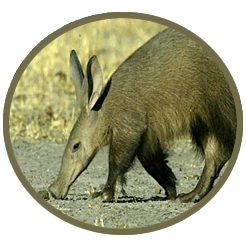
What Do Aardvarks Look Like?
Aardvarks are one of the most unusual-looking animals in Africa! They have long, pig-like snouts that they use to sniff out food underground. Their name "aardvark" comes from Afrikaans words meaning "earth pig"! But aardvarks aren't related to pigs at all-they're actually in their own unique mammal family all by themselves.
These stocky animals have arched backs, thick skin, and sparse hair. Their skin is grayish-brown or pinkish-gray, and they have very little fur covering their tough hide. Aardvarks have long, rabbit-like ears that can rotate to catch sounds from all directions. Their ears are so sensitive they can hear termites moving underground!
Aardvarks have incredibly powerful legs and huge claws! Their front feet have four toes with large, spade-like claws that work like shovels. They can dig faster than a person with a shovel! Their back feet have five toes with smaller claws. They also have a thick, muscular tail like a kangaroo's that helps them balance when they're sitting or digging. Everything about an aardvark is designed for digging!
Where Do Aardvarks Live?
Aardvarks live only in Africa, south of the Sahara Desert! You can find them in many different habitats including grasslands, savannas, woodlands, and scrublands. They need areas where the soil is soft enough to dig and where there are plenty of termites and ants to eat.
These animals are found all across sub-Saharan Africa, from Senegal in the west to Ethiopia in the east, and down to South Africa in the south. They avoid very dry deserts because there aren't enough insects, and they don't live in rainforests because the soil is too hard to dig. The perfect aardvark home has loose, sandy soil and lots of termite mounds!
Aardvarks are expert burrow builders! They dig extensive underground burrows that can be 40 feet long with multiple entrances and chambers. Their burrows provide cool shelter during the hot African day. Aardvarks often change homes, abandoning old burrows and digging new ones. Other animals like warthogs, porcupines, and ground squirrels love to move into abandoned aardvark burrows!
What Do Aardvarks Eat?
Aardvarks are insectivores, which means they eat insects! Their favorite foods are termites and ants-they can eat up to 50,000 insects in a single night! That's a lot of tiny meals. Aardvarks have been designed perfectly for finding and eating these small insects.
These amazing animals hunt at night using their incredible sense of smell. An aardvark's snout is so sensitive it can smell termite colonies underground! When they find a termite mound or ant nest, they use their powerful claws to tear it open. Then comes the really cool part-they stick their long, sticky tongue inside to lap up the insects!
An aardvark's tongue is amazing! It can be up to 12 inches long and is covered in thick, sticky saliva. The tongue shoots in and out rapidly, catching hundreds of insects at a time. Aardvarks also have thick skin on the inside of their nostrils that they can close to keep insects from crawling up their nose! They have very few teeth-just some peg-like molars in the back of their mouth that help grind up insects.
Baby Aardvark Facts
Baby aardvarks are called cubs or pups, and they're adorable! Female aardvarks are pregnant for about 7 months before giving birth. They usually have just one baby at a time, though twins are occasionally born. Babies are born in the safety of underground burrows.
Newborn aardvarks are tiny and helpless! They weigh only about 4 pounds and have soft, pink skin with no hair. Their eyes are closed for the first few weeks. The mother aardvark nurses her baby with milk and keeps it warm in the burrow. For the first two weeks, the baby stays in the burrow while mom goes out to hunt at night.
When the cub is about 2-3 weeks old, it starts to grow hair and open its eyes. At around 2-3 months old, young aardvarks start following their mothers on nighttime hunting trips. The mother teaches her baby how to find termite mounds and dig them open. Young aardvarks are excellent students and quickly learn the family business!
Baby aardvarks stay with their mothers for about 6 months. During this time, they gradually learn to hunt on their own. Eventually, the young aardvark digs its own burrow nearby. By the time they're about 2 years old, aardvarks are fully grown and ready to live independently.
Why Are Aardvarks Special?
Aardvarks are remarkable animals with incredible adaptations! They're so unique that they don't fit into any other animal family-they have their own order (Tubulidentata) all to themselves! No other living mammal is closely related to aardvarks. They're truly one of a kind!
These amazing diggers play a crucial role in African ecosystems. By digging burrows, they create homes for dozens of other animal species. By eating termites, they help control insect populations. When they tear open termite mounds looking for food, they actually help spread nutrients through the soil, which helps plants grow!
Aardvarks are also important to local cultures in Africa. In some areas, aardvarks are considered symbols of good luck. Their burrows are valued by local people as potential sources of water during droughts-water sometimes collects in deep aardvark burrows!
These gentle, shy animals rarely bother anyone and spend their lives peacefully eating insects and digging burrows. They show us that nature creates amazing diversity-sometimes producing totally unique animals that don't quite fit any category! Aardvarks are special reminders of how wonderful and varied life on Earth can be!