What Do Anteaters Look Like?
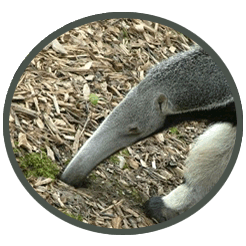
Anteaters are some of the most unusual-looking mammals! They have long, tube-shaped snouts with tiny mouths at the end-just big enough for their tongue to slip through. Their snouts can be over a foot long! Anteaters don't have any teeth at all. Instead, they rely on their amazing tongues to catch food.
There are four species of anteaters. Giant anteaters are the largest-they can be 6-7 feet long from nose to tail! They have coarse gray fur with distinctive white and black stripes running from their chest to their back. Their bushy tails are almost as long as their bodies and look like giant feather dusters! Silky anteaters are the smallest-only about 14 inches long with soft, golden fur. Tamanduas are medium-sized with tan and black fur patterns.
All anteaters have powerful front legs with huge, curved claws. Giant anteaters have claws that can be 4 inches long! These claws are so large and curved that anteaters walk on their knuckles to keep them sharp. The claws are perfect for tearing open termite mounds and ant nests. Anteaters also have small eyes and ears, but their sense of smell is incredible-40 times better than humans!
Where Do Anteaters Live?
Anteaters live in Central and South America! Giant anteaters are found from Honduras in Central America down through most of South America, including countries like Brazil, Paraguay, and Argentina. They prefer grasslands, savannas, and dry forests where termite mounds are plentiful.
Silky anteaters and tamanduas are tree-dwellers! They live in tropical rainforests from southern Mexico to Brazil. Silky anteaters rarely come down from the trees-they're perfectly adapted for life in the canopy. Tamanduas spend time both in trees and on the ground, making them versatile hunters.
Each type of anteater is suited to its habitat! Giant anteaters roam the ground on their powerful legs, traveling several miles each day searching for ant and termite colonies. Tree-dwelling anteaters have prehensile tails (tails that can grip branches) that work like an extra hand, helping them climb and hang from branches while feeding. All anteaters need habitats with plenty of insects to eat!
What Do Anteaters Eat?
Anteaters are specialized insect eaters! As their name suggests, they eat mostly ants and termites. A giant anteater can eat up to 30,000 insects in a single day! That's a lot of tiny meals. Anteaters have been perfectly designed for finding and eating these small insects.
Here's how anteaters hunt: They use their excellent sense of smell to locate ant or termite nests. When they find one, they use their powerful claws to tear it open. Then they stick their long, sticky tongue inside and slurp up the insects! An anteater's tongue is covered in thick, sticky saliva that traps insects like flypaper.
The anteater's tongue is absolutely amazing! It can extend over 2 feet long and flicks in and out up to 150 times per minute-that's more than twice per second! The tongue is so long it's actually attached near the anteater's breastbone, not just in its mouth. After catching insects on their sticky tongue, anteaters swallow them whole. Because they have no teeth, their strong stomach muscles and stomach acids grind up and digest the insects.
Baby Anteater Facts
Baby anteaters are called pups, and they're adorable! Female anteaters are pregnant for about 6 months before giving birth. They usually have just one baby at a time. Giant anteater mothers give birth while standing up, and the baby is born ready to cling to mom's back!
Newborn anteaters look like miniature versions of their parents. Baby giant anteaters have the same distinctive striped pattern as adults. The pup immediately climbs onto its mother's back, where it will ride for most of its first year! The baby's stripes blend perfectly with the mother's stripes, making it hard for predators to see where mom ends and baby begins-it's built-in camouflage!
Mother anteaters are very protective of their babies! The pup stays on mom's back while she searches for food. When the mother feeds, the baby sometimes climbs down to watch and learn. At around 6 months old, young anteaters start eating insects on their own, but they continue riding on mom's back and nursing until they're about a year old.
Young anteaters stay with their mothers for up to 2 years, learning everything they need to know about finding ant and termite colonies. The mother teaches her pup which insects are good to eat and how to avoid getting bitten too much. Eventually, the young anteater ventures off to find its own territory and start its own insect-hunting lifestyle!
Why Are Anteaters Special?
Anteaters are extraordinary animals with remarkable adaptations! Their incredibly long tongues, powerful claws, and toothless mouths make them perfectly suited for eating ants and termites. No other animal hunts insects quite like an anteater!
These amazing mammals play an important role in their ecosystems. By eating millions of ants and termites, they help control insect populations. When they tear open ant and termite nests, they create opportunities for other animals to feed on the insects too. Birds, lizards, and small mammals often follow anteaters to catch insects that escape!
Sadly, giant anteaters are vulnerable due to habitat loss and hunting. Grasslands and savannas where they live are being converted to farmland. Conservation programs are working to protect anteater habitats and educate people about these unique animals. Many countries have made it illegal to hunt anteaters.
Anteaters remind us of nature's incredible diversity! They show us that animals can develop amazing specialized features for unique lifestyles. From their 2-foot tongues to their powerful claws and toothless mouths, everything about anteaters is perfectly designed for their ant-eating way of life. These wonderful mammals are true marvels of the natural world!