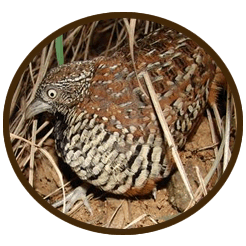
What Do Button-Quails Look Like?
Button-quails are tiny, round birds that look like little balls of feathers! They have short tails, small heads, and plump bodies. Most button-quails are only 4 to 7 inches long. That's about the size of a tennis ball! Their feathers are brown, tan, and gray with streaks and spots. These earthy colors help them hide perfectly in dry grass and leaves!
Female button-quails are bigger and more colorful than males! This is the opposite of most bird species. Female button-quails have brighter chest patches and bolder markings. Males are smaller and duller. The painted button-quail from Australia is one of the most colorful species with a red eye and spotted chest. The barred button-quail has beautiful striped patterns!
Button-quails have a special feature-they only have three toes! Most birds have four toes. Button-quails lost their back toe. Having only three forward-facing toes helps them run quickly through thick grass. They have short, strong bills suited for picking up seeds and insects. Their legs are short but powerful. Button-quails spend almost their entire lives on the ground!
Where Do Button-Quails Live?
Button-quails live across Africa, Asia, and Australia! The common button-quail lives in grasslands from Spain to Southeast Asia. The painted button-quail is found throughout Australia. The black-breasted button-quail lives in dry forests of eastern Australia. Yellow-legged button-quails live in parts of Africa. Altogether, there are 16 species spread across the warm parts of the world!
These little birds love open grasslands and scrubby areas! They prefer places with thick ground cover where they can hide. Farmlands with stubble left after harvesting are perfect button-quail habitat. They also live in open woodlands, savanna edges, and weedy fields. Button-quails avoid thick forests and very wet areas!
Button-quails are very hard to spot in the wild! They freeze when danger comes near, trusting their camouflage. If they do move, they run through the grass rather than fly. When forced to fly, they burst up with a whirring of wings and fly low for a short distance before dropping back into the grass. Most people have never seen a wild button-quail even if they live nearby!
What Do Button-Quails Eat?
Button-quails eat seeds, grain, and small insects! They scratch through leaf litter and grass to find food. Seeds from grasses and weeds make up most of their diet. They also eat small beetles, ants, caterpillars, and spiders. Button-quails pick food up from the ground with their short, strong bills!
Button-quails have a funny way of finding food! They spin in circles on one foot while scratching the ground with the other. This spinning creates a small bare spot in the leaf litter called a "platelet." The scratching uncovers hidden seeds and insects. If you find little round bare patches on the ground in grassland, button-quails may have been feeding there!
Baby button-quails can feed themselves from their very first day! Father button-quails show their chicks where to find food by tapping on the ground with their bills. The chicks quickly learn to scratch and peck for themselves. Button-quail chicks eat mostly small insects at first because they need the protein to grow. They switch to more seeds as they get bigger!
Baby Button-Quail Facts
Female button-quails lay 3 to 5 eggs in a simple ground nest! The nest is just a shallow scrape in the ground lined with grass and leaves. The eggs are pale with dark spots that help them blend in with the surroundings. After laying the eggs, the female leaves. The male takes over all nesting duties!
Father button-quails sit on the eggs for about 12 to 14 days! That's a very short incubation period for a bird. The male barely moves from the nest during this time. His dull feathers help camouflage him while he sits. If a predator comes too close, the male may perform a broken-wing display to lead the danger away from the eggs!
Button-quail chicks hatch covered in fluffy, striped down! They can stand and walk almost right away. Within hours, the chicks follow their father away from the nest. They never return to it. The father leads his chicks through the grassland, showing them how to find food by tapping the ground with his bill!
Baby button-quails grow at an incredible rate! They can flutter-fly at just 7 to 10 days old. By 2 weeks, they can fly short distances. Chicks become fully independent at about 3 to 4 weeks old. Some species can breed when they're only 3 to 4 months old. This fast growth helps button-quails survive since many chicks are eaten by predators like snakes, hawks, and cats!
Why Are Button-Quails Special?
Button-quails show us that animal families can work in many different ways! Their role-reversed parenting-where mothers lay eggs and leave, while fathers do all the childcare-is rare among birds. Only a few other bird groups share this system. Button-quails prove there's no single "right" way to raise a family in nature!
These tiny birds are important members of grassland habitats! By eating seeds and insects, they help control plant and pest populations. Their scratching and spinning while feeding turns over leaf litter and aerates soil. Button-quails also provide food for hawks, snakes, and other predators. They're small but they play a big role in their ecosystems!
Some button-quail species face serious threats! The black-breasted button-quail of Australia is endangered. Habitat loss from farming and development destroys the grasslands these birds need. Cats and foxes also kill many button-quails. Conservation groups are working to protect remaining button-quail habitat and control introduced predators!
Button-quails remind us that amazing wildlife can be hiding right under our feet! These little birds are so secretive that most people never see them. But they're out there in grasslands around the world, spinning for seeds and raising their families. The next time you walk through a grassy field, take a moment to wonder what small creatures might be hiding just a few steps away!