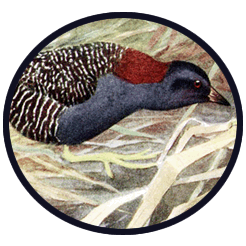
What Do Rails Look Like?
Rails have flat, narrow bodies that help them squeeze through dense marsh vegetation! Their bodies are literally thinner from side to side than most birds. This is where the saying "thin as a rail" comes from! Most rails are brown, gray, or olive colored with streaked or barred patterns. Their dull colors provide excellent camouflage among reeds and cattails!
Rails have long toes that help them walk on floating plants! Their toes spread wide to distribute their weight, like built-in snowshoes. Purple gallinules have especially long toes and can walk across lily pads without sinking. Most rails have short, rounded wings. Their tails are short and often held upright, flicking up and down as they walk!
Different rail species have very different bills! Virginia rails have long, curved bills for probing mud. Sora rails have short, stubby yellow bills for eating seeds. Moorhens and gallinules have brightly colored shields on their foreheads-red in moorhens and blue in purple gallinules. These colorful face shields help birds recognize each other in the dark marsh!
Where Do Rails Live?
Rails live in marshes, swamps, and wetlands on every continent except Antarctica! King rails live in freshwater marshes of eastern North America. Clapper rails prefer saltwater marshes along the coasts. Virginia rails are found in cattail marshes across the United States and Canada. Moorhens and gallinules live in ponds, lakes, and marshes around the world!
Rails need dense vegetation to feel safe! They live among cattails, reeds, bulrushes, and other tall marsh plants. Without thick cover, rails won't stay in an area. They build their nests among the vegetation, often over water. Some rails also live in wet meadows, rice fields, and even overgrown ditches. Anywhere with water and dense plants can be rail habitat!
Many island rails became flightless because they had no predators! Islands worldwide once had unique flightless rail species. Sadly, when humans brought cats, rats, and other predators to these islands, many flightless rails went extinct. More rail species have gone extinct than any other bird family. At least 21 rail species have disappeared since humans started exploring the Pacific islands!
What Do Rails Eat?
Rails eat a wide variety of foods! They're omnivores that eat insects, snails, worms, small crabs, seeds, berries, and aquatic plants. Virginia rails probe soft mud for insects and worms with their long bills. Soras pick seeds and grain from the marsh surface. Moorhens eat everything from algae to tadpoles. Rails are not picky eaters!
Rails hunt by walking slowly through shallow water and vegetation! They flip over leaves, probe mud, and peck at anything that moves. Some rails stamp their feet to scare up insects hiding in the mud. King rails eat crayfish, frogs, and even small fish. Purple gallinules walk across lily pads, picking seeds and insects from the water's surface!
Rails are most active at dawn and dusk! During the day, they hide deep in marsh vegetation. As light dims, they become more active and bold, venturing into open areas to feed. On moonlit nights, some rails feed throughout the night. Their large eyes help them see well in low light. Many rails also migrate at night, flying under the cover of darkness!
Baby Rail Facts
Rails build their nests among thick marsh vegetation! The nest is a cup or platform of dead reeds and grasses, usually hidden among cattails or sedges. Many rails build the nest over shallow water. Some species add a canopy of bent-over vegetation to hide the nest from above. Both parents work together to build the nest!
Most rails lay 6 to 12 eggs! The eggs are usually cream or buff colored with brown spots. Both parents take turns sitting on the eggs. Incubation takes about 18 to 24 days depending on the species. If a predator finds the nest, rails may try to lure it away with a distraction display, pretending to be injured!
Baby rails are among the cutest chicks in the bird world! They hatch covered in fluffy black down that looks like soft velvet. Rail chicks can walk, swim, and leave the nest within hours of hatching. Both parents feed the chicks, placing tiny insects and worms into their little bills. The family moves through the marsh together, with chicks following the parents!
Young rails grow quickly and can fly at about 7 to 9 weeks old! Until then, they hide in the marsh vegetation when danger approaches. Some rail parents divide the brood-the mother takes half the chicks and the father takes the other half. By late summer, young rails are fully independent. Many will migrate south for their first winter, flying at night over vast distances!
Why Are Rails Special?
Rails are masters of hiding in plain sight! They live all around us in marshes and wetlands, yet most people have never seen one. Their secretive lifestyle makes them some of the most mysterious birds in the world. Hearing a rail calling from a marsh is a thrilling experience for bird lovers!
Rails are incredibly important for wetland ecosystems! They eat pest insects and spread seeds of marsh plants. Their presence tells scientists that a wetland is healthy. When rails disappear from a marsh, it's a warning sign that something is wrong with the habitat!
Many rail species are in trouble! Wetland drainage is the biggest threat to rails worldwide. When marshes are filled in for development, rails lose their homes. Pollution, invasive plants, and rising sea levels also harm rail habitats. Island rails face threats from introduced predators. Protecting wetlands is the best way to save rails!
Rails remind us how much wildlife depends on wetlands! These hidden birds need healthy marshes, swamps, and bogs to survive. When we protect wetlands for rails, we also protect fish, frogs, turtles, and countless other species. Rails are the secret keepers of the marsh-and their wetland homes are worth protecting!