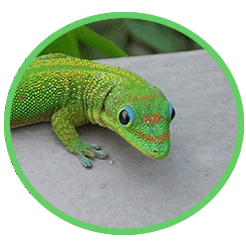
What Do Chameleons Look Like?
Chameleons have some of the most unique bodies in the animal kingdom! Their eyes sit in cone-shaped turrets that can rotate independently-each eye can look in a completely different direction at the same time! This gives them nearly 360-degree vision without moving their heads. When a chameleon spots a tasty bug, both eyes lock onto the target to judge the distance perfectly. Their eyes are like built-in binoculars!
A chameleon's body is designed for life in the trees! Their feet are split into two groups of toes that grip branches like tiny pliers. Their curly, prehensile tails wrap around branches for extra safety-like having a fifth hand! Chameleons walk with a slow, swaying motion that makes them look like leaves blowing in the wind. Their bodies are tall and flat from side to side, which also makes them look like leaves when viewed from the front!
Chameleons come in many sizes! The Parson's chameleon from Madagascar can grow to 27 inches long-over 2 feet! The Brookesia micra is one of the smallest reptiles in the world, small enough to stand on the head of a match! Veiled chameleons have tall, helmet-shaped crests on their heads called casques. Panther chameleons are famous for their brilliant rainbow colors. Jackson's chameleons have three horns on their heads like tiny triceratops!
Where Do Chameleons Live?
Most chameleons live in Africa and Madagascar! About half of all chameleon species are found only on the island of Madagascar, off the coast of Africa. These lizards have lived on this island for so long that they come in an incredible variety of shapes and sizes. A few species also live in southern Europe, the Middle East, and parts of Asia. Chameleons have even been introduced to Florida and Hawaii!
Chameleons are tree-dwelling experts! Most species spend their entire lives in trees and bushes, rarely coming down to the ground. They live in tropical rainforests, mountain forests, and even dry scrublands. Some species prefer the very tops of tall trees while others stay in low bushes near the ground. The tiny Brookesia chameleons actually live in leaf litter on the forest floor, where their brown coloring makes them almost invisible!
Each chameleon species has its own favorite habitat! Veiled chameleons live in the mountain valleys of Yemen and Saudi Arabia where it is dry and warm. Panther chameleons love the humid tropical forests of northern Madagascar. Jackson's chameleons live in the cool mountain forests of Kenya and Tanzania. Some chameleons can handle temperatures near freezing at night, while others need warmth all year round!
What Do Chameleons Eat?
Chameleons eat insects-and they catch them in the most amazing way! A chameleon sits perfectly still on a branch, scanning for prey with its rotating eyes. When it spots a cricket or grasshopper, both eyes lock on. Then-SNAP!-its tongue shoots out and back in just 0.07 seconds! The tongue can be one and a half to two times the length of the chameleon's entire body. A sticky, suction-cup tip grabs the insect and pulls it back to the chameleon's waiting mouth!
The chameleon tongue is one of nature's most amazing weapons! It accelerates from 0 to 60 mph in one-hundredth of a second-faster than a jet fighter launching from an aircraft carrier! The tip produces a sticky mucus that is 400 times stickier than human saliva. Small chameleons have even faster tongues than big ones, relative to their body size. The tongue works like a spring-loaded catapult, storing energy in elastic tissue before release!
Chameleons eat a variety of small creatures! Crickets, grasshoppers, flies, moths, and beetles are their favorite meals. Larger chameleons also eat small lizards, baby birds, and even small snakes! Veiled chameleons are unusual because they also eat plant leaves and flowers for extra water and nutrition. Chameleons drink water by licking dewdrops and rain off leaves-they do not drink from puddles or bowls. In the wild, morning dew is an important water source!
Baby Chameleon Facts
Most chameleons lay eggs! The mother digs a hole in the ground, lays her eggs, covers them up, and leaves. The eggs can take 4 to 12 months to hatch depending on the species. Veiled chameleons lay 30 to 80 eggs at a time! Some mountain-dwelling chameleons give birth to live babies instead of laying eggs-this helps the babies survive in cooler climates where eggs might not stay warm enough!
Baby chameleons are tiny but fully formed! They can grip, climb, catch insects with their tongues, and change color from the moment they hatch. Newborn panther chameleons are only about 2 inches long. Baby Jackson's chameleons are born with tiny horn bumps that grow into full horns as they age. Young chameleons are usually brown or green to blend in with their surroundings and avoid predators!
Baby chameleons are completely on their own from birth! Mother chameleons do not care for their babies at all. Hatchlings must immediately find food, water, and shelter by themselves. They start catching tiny insects like fruit flies and gnats right away. Baby chameleons grow quickly during their first year, shedding their skin regularly as they get bigger. They can reach adult size in just 6 to 12 months!
Some chameleon species have surprisingly short lives! The Labord's chameleon from Madagascar has the shortest lifespan of any four-legged animal-it lives for only about 4 to 5 months after hatching! The entire adult population dies each year, and only eggs survive to start the next generation. Other chameleon species live much longer-Parson's chameleons can live over 12 years. Males generally have shorter lifespans than females in most chameleon species!
Why Are Chameleons Important?
Chameleons are important insect controllers in their habitats! They eat large numbers of flies, mosquitoes, crickets, and other insects every day. In gardens and farms, chameleons help keep pest populations in check naturally. A single chameleon can eat dozens of insects per day, reducing the need for chemical pest control. These hungry hunters are excellent friends for farmers and gardeners!
Chameleons are important for scientific research! Scientists study chameleon color change to develop new technologies for camouflage, display screens, and smart materials. The super-fast chameleon tongue has inspired new robotic gripper designs. Chameleon eyes have helped engineers develop better camera systems. These amazing reptiles are teaching us lessons that lead to real-world inventions!
Many chameleon species face serious threats! Over one-third of all chameleon species are considered threatened. Habitat loss from deforestation is the biggest danger, especially in Madagascar where many unique species live. The pet trade also threatens wild populations. Some chameleon species live in tiny areas and could be wiped out by a single event. Protected forests and responsible pet ownership are key to their survival!
Chameleons remind us how wonderfully creative nature can be! Their color-changing skin, rocket-powered tongues, rotating eyes, and grippy feet are just a few of the amazing features packed into these small reptiles. Each species is uniquely designed for its particular habitat and lifestyle. By protecting chameleon habitats, especially the forests of Madagascar and Africa, we preserve some of the most remarkable animals on Earth!
Cool Facts About Chameleon!
- Color-changing magic: Chameleons change color-but NOT mainly for camouflage! They change color to communicate with other chameleons, regulate their body temperature, and show their mood. An angry chameleon turns dark. A relaxed one shows lighter colors. Males display bright colors to attract females or warn rival males. The color change happens when special cells in their skin called chromatophores expand or shrink to show different pigments!
- Rocket tongues: A chameleon's tongue is its secret weapon! It can shoot out and back in just 0.07 seconds-so fast that prey never sees it coming. The tongue accelerates at 41 g-forces, which means it speeds up faster than a fighter jet! The sticky tip can hold prey weighing up to one-third of the chameleon's own body weight. Chameleons can catch insects from over a body length away without moving anything except their tongue!
- Independent eyes: Chameleon eyes are truly extraordinary! Each eye can rotate up to 180 degrees and move completely independently of the other. One eye can look forward while the other looks backward! This gives the chameleon a nearly complete view of its surroundings without turning its head. When both eyes lock onto the same target, the chameleon has depth perception to aim its tongue with incredible accuracy!
- Tiny champions: Some chameleons are incredibly small! The Brookesia nana from Madagascar may be the smallest reptile in the world-adult males are just over half an inch long! They are so tiny that they can perch comfortably on the tip of your finger. Despite their size, they are perfectly formed chameleons with all the same features as their larger relatives. Scientists did not discover some of these tiny species until recently!
- Grip masters: Chameleons have amazing feet for tree life! Their toes are fused into two groups-like having mittens instead of gloves-that clamp onto branches from both sides. Their prehensile tails can grip branches tightly and support the chameleon's entire weight. Even baby chameleons can grip and climb within minutes of hatching. The combination of grippy feet and a curling tail makes chameleons some of the best climbers in the animal kingdom!
- Cool crests and horns: Many chameleons have awesome head decorations! Jackson's chameleons have three horns-two above the eyes and one on the nose-that they use in jousting matches with rival males. Veiled chameleons have tall casques (crests) on their heads that help collect water from morning dew, which trickles down to their mouths. Panther chameleons have bony ridges above their eyes that make them look like tiny dragons!
- Slow-motion walkers: Chameleons move in a unique, swaying walk! They rock back and forth as they step, which makes them look like leaves blowing in the wind. This slow, deliberate movement helps them avoid being spotted by predators. But when they need to, chameleons can move surprisingly quickly! Males chasing rivals or fleeing from danger can scurry along branches at impressive speeds. Their walking style is so distinctive that you can identify a chameleon from far away!
- UV glow: Some chameleons have bony ridges on their heads that glow under ultraviolet light! Scientists recently discovered that certain chameleon species have fluorescent bone tubercles that shine bright blue under UV light. These glowing patterns may help chameleons find each other in dense forests. The patterns are different on each chameleon, working like a unique identification badge. Chameleons can see UV light that humans cannot!