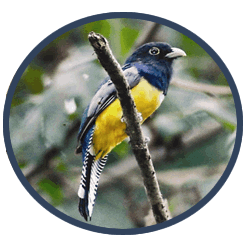
What Do Trogons Look Like?
Trogons are among the most colorful birds in the world! Males typically have bright, metallic green or blue backs and heads, with vivid red, orange, or yellow bellies. Females are usually duller but still attractive. Their soft, dense feathers have a metallic sheen that changes color as light hits them from different angles. Trogon feathers are so delicate that they fall out easily when touched!
The resplendent quetzal is the most famous and beautiful trogon! Male quetzals have shimmering emerald green feathers, a bright red chest, and tail feathers that trail over 2 feet behind them like flowing ribbons. Their green feathers shift between blue and gold depending on the light. The quetzal is often called the most beautiful bird in the Western Hemisphere!
Trogons have unique feet that are different from all other birds! Their first and second toes face backward, while the third and fourth face forward. This arrangement is called heterodactyl and is found only in trogons. Their small, weak feet are designed for perching, not walking. Trogons almost never walk-they sit still on branches and sally out to catch food!
Where Do Trogons Live?
Trogons live in tropical and subtropical forests around the world! Most species are found in Central and South America. The resplendent quetzal lives in the cloud forests of Mexico and Central America. Several trogon species live in the forests of sub-Saharan Africa. A few species are found in the tropical forests of Southeast Asia. All trogons need mature, dense forests!
Trogons are birds of the forest interior! They perch quietly on branches in the middle and upper levels of the forest canopy. They rarely come to the ground or venture into open areas. Trogons prefer areas with plenty of fruit trees and large dead trees for nesting. They need forests with natural tree holes, as they don't build nests on their own!
Cloud forests are the favorite habitat of quetzals! These misty mountain forests sit at elevations of 4,000 to 10,000 feet. Clouds and fog wrap the trees in moisture, supporting thick moss and orchid growth. Quetzals eat the fruit of wild avocado trees that grow in these forests. The cool, misty climate is perfect for these spectacular birds!
What Do Trogons Eat?
Trogons eat a mix of fruit and insects! They perch quietly on a branch, scanning the area for food. When they spot a ripe fruit or a juicy insect, they hover briefly and snatch it. Trogons eat many kinds of tropical fruits, berries, and seeds. They also eat caterpillars, beetles, moths, cicadas, and even small lizards and frogs!
Quetzals are especially fond of wild avocados! They swallow the small, wild avocado fruit whole. After digesting the flesh, they spit out the large seed. This makes quetzals important seed dispersers for avocado trees. Without quetzals and other fruit-eating birds, many tropical trees couldn't spread their seeds to new areas!
Trogons use a hunting technique called sally-gleaning! They sit motionless on a branch, watching for movement. When they spot an insect, they launch off the perch, hover next to a leaf or branch, pluck the insect, and return to their perch. This sit-and-wait style means trogons spend a lot of time sitting very still, which makes them hard to spot despite their bright colors!
Baby Trogon Facts
Trogons nest in tree holes in dead or rotting trees! Both parents help prepare the nest hole, sometimes enlarging it by chipping away at soft wood with their bills. The hole is usually 5 to 50 feet above the ground. No nesting material is added-the eggs sit on bare wood. Quetzal nest holes are easy to spot because the male's long tail feathers stick out of the entrance!
Female trogons lay 2 to 4 eggs that are white or pale blue! Both parents take turns keeping the eggs warm. Incubation lasts about 15 to 19 days depending on the species. The parents switch duties several times a day. While one parent sits, the other hunts for food. Trogon parents are quiet and careful near the nest to avoid attracting predators!
Baby trogons hatch naked and helpless! Their eyes are closed, and they have no feathers at all. Both parents feed the chicks insects and fruit. As the chicks grow, their colorful feathers begin to emerge. Baby trogons grow quickly on their protein-rich diet of insects. By about 15 to 17 days old, they're ready to leave the nest!
Young trogons stay near their parents for a few weeks after leaving the nest! They learn to catch insects and find fruit by watching their parents. Young trogons are duller in color than adults. As they mature, males gradually develop their brilliant metallic colors. By their first breeding season, young trogons have their full adult plumage!
Why Are Trogons Special?
Trogons are living works of art! Their iridescent feathers, vibrant colors, and elegant forms make them among the most beautiful birds on Earth. The resplendent quetzal is considered by many to be the most beautiful bird in the Western Hemisphere. Trogons bring color and wonder to tropical forests around the world!
Trogons are vital for tropical forest health! By eating fruit and spreading seeds, they help forests regenerate and grow. Wild avocado trees depend heavily on quetzals for seed dispersal. When trogon populations decline, the trees they depend on may also suffer. Trogons and their forest homes are closely connected!
Many trogon species face threats from deforestation! As tropical forests are cut down, trogons lose their homes and food sources. The resplendent quetzal is classified as Near Threatened. Cloud forest habitat is disappearing due to farming and development. Protecting tropical forests is essential for trogon survival!
Trogons inspire conservation efforts around the world! The beauty of the quetzal has made it a symbol for protecting tropical forests. Ecotourism based on quetzal watching brings money to local communities. When people see these magnificent birds, they understand why forests are worth saving. Trogons prove that beauty can be a powerful force for conservation!