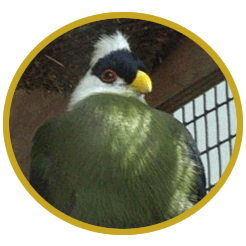
What Do Turacos Look Like?
Turacos are medium-sized birds with long tails, rounded wings, and beautiful crests! The green turaco group has rich green feathers, red flight feathers, and tall crests. The great blue turaco is about 30 inches long with stunning blue and green plumage and a yellow-tipped red crest. Ross's turaco is deep violet-blue with a bright red crest. Every turaco species is eye-catching!
Turaco feathers contain unique pigments found nowhere else in nature! The green color comes from a pigment called turacoverdin-the only truly green pigment in any bird's feathers. The red color comes from turacin, which contains copper. If you put a turaco's red feather in slightly alkaline water, the red pigment dissolves and the water turns pink! No other bird feathers do this!
Turacos have special feet designed for running along branches! Their fourth toe can rotate forward or backward, giving them a flexible grip. This lets them run along tree branches with amazing speed and agility. Turacos are often called "go-away birds" because some gray species have calls that sound like they're saying "go away!" Their crests rise and fall with their mood!
Where Do Turacos Live?
Turacos live only in Africa! They're found across sub-Saharan Africa in forests, woodlands, and savannas. Green turacos live in dense tropical and montane forests. The great blue turaco lives in the rainforests of Central and West Africa. Gray turacos and go-away birds live in more open woodlands and savannas of eastern and southern Africa!
Most turacos are forest canopy birds! They spend their time in the upper levels of trees, running along branches and leaping between them. They rarely come to the ground. Green turacos are hard to spot despite their bright colors because the forest canopy is also green. You usually hear their loud calls before you see them. Go-away birds are easier to spot in their open habitats!
Turacos are non-migratory-they stay in the same area year-round! They defend territories, especially during breeding season. Some species are quite social and live in small family groups. Others are more solitary. All turacos need trees with plenty of fruit. They're found from sea level up to mountain forests at over 10,000 feet elevation!
What Do Turacos Eat?
Turacos eat mainly fruit! They're among the most important fruit-eating birds in African forests. Turacos eat figs, berries, and many other tropical fruits. They pluck fruit while perched or while hovering briefly near a branch. Some species also eat leaves, flowers, and buds. A few turacos occasionally eat small insects and snails too!
Turacos are important seed spreaders! When they eat fruit, they swallow it whole. The seeds pass through their digestive system and are deposited far from the parent tree. This helps forests grow and spread. Many African trees depend on turacos and other fruit-eating birds for seed dispersal. Without turacos, some forests would struggle to regenerate!
Go-away birds and gray turacos eat more leaves than their forest cousins! Living in drier habitats with less fruit, they've adapted to eat leaves, flowers, and plant shoots. This makes them unusual among birds, as very few birds eat leaves regularly. Their digestive systems are designed to break down tough plant material. They supplement their diet with berries and insects when available!
Baby Turaco Facts
Turacos build flat, flimsy nests of twigs and sticks in trees! The nest looks like a loose platform, similar to a pigeon's nest. It's usually hidden among dense foliage 10 to 30 feet above the ground. Both parents build the nest together. Compared to the birds' beauty, their nests are surprisingly plain and simple!
Female turacos lay 2 to 3 white or pale-colored eggs! Both parents take turns sitting on the eggs. Incubation lasts about 21 to 24 days. The parents are very attentive, rarely leaving the eggs unattended. They become quiet and secretive near the nest to avoid attracting predators. Some species have helpers-older siblings that assist with incubation!
Baby turacos are covered in thick, dark down when they hatch! Unlike many birds, turaco chicks are fairly active from a young age. By about 10 days old, chicks can scramble out of the nest and climb around nearby branches using their feet and tiny wing claws. This climbing ability helps them escape predators. They can't fly yet but are excellent little climbers!
Young turacos can fly at about 4 to 5 weeks old! They stay with their family group for several months, learning to find fruit and navigate the forest canopy. In some species, young birds from previous years help their parents raise the next batch of chicks. Young turacos gradually develop their adult colors over their first year. Family bonds can be quite strong!
Why Are Turacos Special?
Turacos are scientifically unique among all birds! Their green and red pigments exist nowhere else in nature. No other bird has true green feathers or copper-containing red pigments. Turacos are in a family all their own with no close relatives. They are a truly one-of-a-kind group of birds!
Turacos are among Africa's most beautiful birds! From the jewel-like green turacos of the rainforest to the magnificent great blue turaco, these birds bring color and life to African forests. Birdwatchers travel from around the world to see turacos in the wild. Their beauty makes them ambassadors for African forest conservation!
Most turaco species are doing well, but habitat loss is a concern! As African forests are cut down for farming and development, some turaco species lose their homes. Forest turacos are more vulnerable than the adaptable go-away birds. Protecting African forests ensures that turacos continue to bring their unique colors to the world!
Turacos remind us that nature's palette is endlessly creative! While all other green birds fake their color through light tricks, turacos achieved real green through a unique pigment. Nature found a completely different solution for the same color. These birds prove that the natural world is full of surprises waiting to be discovered!