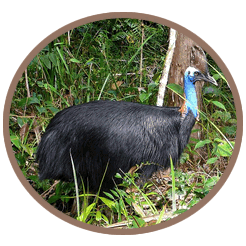
What Do Cassowaries Look Like?
Cassowaries are large, striking birds with an ancient appearance! They stand 5-6 feet tall and have shaggy black feathers that look more like fur. Their most distinctive feature is the casque-a hard, helmet-like structure on top of their heads that can be 7 inches tall! Scientists think the casque might help them push through dense forest vegetation or amplify their deep booming calls.
Cassowaries have brilliantly colored bare skin on their necks and heads! The southern cassowary has bright blue and red skin with colorful wattles (fleshy flaps) hanging from its neck. These vivid colors make cassowaries look both beautiful and intimidating. Different cassowary species have slightly different color patterns, but all are eye-catching!
The most dangerous feature of cassowaries is their feet! They have three toes on each foot, and the innermost toe has a dagger-like claw up to 5 inches long! These claws are sharp as knives and can inflict serious injuries. Cassowaries have powerful, muscular legs capable of delivering devastating kicks. Everything about a cassowary says "don't mess with me!"
Where Do Cassowaries Live?
Cassowaries live only in the tropical rainforests of northeastern Australia and New Guinea! The southern cassowary is found in the rainforests of northern Queensland, Australia. The dwarf cassowary and northern cassowary live in New Guinea and nearby islands. These birds need dense, wet rainforests to survive.
Cassowaries are rainforest specialists! They prefer thick, undisturbed forests with plenty of fruit-bearing trees. They're shy, solitary birds that like to avoid open areas. Cassowaries follow regular routes through the forest, creating tunnels through the dense vegetation as they walk the same paths repeatedly.
These birds are excellent swimmers! Cassowaries will wade through rivers and swim across water bodies when necessary. They're quite comfortable in water despite being large, flightless birds. They also enjoy bathing in forest streams to cool off and clean their feathers!
What Do Cassowaries Eat?
Cassowaries are primarily frugivores, which means they mainly eat fruit! They love rainforest fruits and can swallow large fruits whole-including some as big as tennis balls! Cassowaries eat hundreds of different types of rainforest fruits. Their strong digestive systems can handle fruits that are toxic to other animals.
Here's something amazing-cassowaries are "gardeners of the rainforest!" After eating fruits, they spread the seeds throughout the forest in their droppings. Some rainforest plants rely entirely on cassowaries to spread their seeds! Without cassowaries, certain tree species might disappear. These birds are crucial for rainforest health!
Cassowaries also eat fungi (mushrooms), flowers, snails, insects, and small vertebrates like frogs or fish when they find them. They're opportunistic feeders, meaning they'll eat whatever edible things they encounter. Sometimes they follow other animals to find fallen fruit!
Baby Cassowary Facts
Baby cassowaries are called chicks, and they look quite different from their parents! During breeding season, female cassowaries lay 3-5 large, pale green eggs in a simple nest on the forest floor. The eggs are huge-each one weighs about a pound! The beautiful pale green color helps camouflage them on the forest floor.
After laying eggs, the mother cassowary leaves! The father takes over all parenting responsibilities. He incubates the eggs for about 50 days, rarely leaving the nest. Male cassowaries are extremely protective during this time and can be very aggressive if disturbed!
When cassowary chicks hatch, they're covered in cream and brown striped down! These stripes provide excellent camouflage in the dappled rainforest light. Unlike their dark parents, baby cassowaries are light-colored with bold stripes running down their backs and sides.
The father cassowary stays with his chicks for about 9 months, teaching them what to eat and how to survive in the rainforest! The chicks follow their dad everywhere, learning which fruits are good and how to avoid dangers. Their stripes gradually fade as they grow, and their adult black feathers appear. Young cassowaries develop their casques slowly-the helmet doesn't reach full size until they're several years old!
Why Are Cassowaries Special?
Cassowaries are extraordinary birds that play irreplaceable roles in rainforest ecosystems! They're living links to ancient times, looking and acting much like birds from long ago. Their unique appearance with colorful necks and helmet-like casques makes them instantly recognizable and unforgettable.
These magnificent birds are crucial to rainforest health! As seed dispersers for over 150 plant species, cassowaries maintain rainforest diversity. Some large rainforest fruits can only be spread by cassowaries-no other animal can swallow and disperse these seeds. Without cassowaries, entire plant communities could collapse!
Sadly, cassowaries face serious threats! Habitat loss from rainforest clearing, vehicle strikes on roads through their territory, and attacks from dogs endanger these birds. The southern cassowary is listed as endangered in Australia. Conservation programs work to protect cassowary habitat and reduce road deaths.
Cassowaries remind us that even "dangerous" animals serve vital purposes in nature! While they deserve respect and should never be approached in the wild, these remarkable birds are essential rainforest guardians. By protecting cassowaries, we protect entire rainforest ecosystems. They truly are irreplaceable treasures of the tropical forests!