What Do Geckos Look Like?
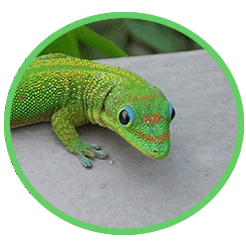
Geckos come in an amazing variety of colors and patterns! Leopard geckos have spotted yellow and brown skin that looks like a tiny leopard. Crested geckos have a fringe of skin running from their eyes down their backs like a little crown. Day geckos are bright green with red spots. Leaf-tailed geckos from Madagascar look exactly like dead leaves-bark texture, bite marks, and all! Geckos can be green, brown, yellow, orange, blue, or even bright pink!
Most geckos have big eyes with vertical slit pupils, like tiny cat eyes! Their eyes are covered by a clear, fixed scale instead of movable eyelids-so geckos cannot blink! To keep their eyes clean and moist, most geckos lick their eyeballs with their long tongues. Watching a gecko clean its own eyeball is one of the funniest things in the reptile world! Some geckos have round pupils and are active during the day, but most are nocturnal with slit pupils for night vision!
Gecko toes are their most famous feature! Most geckos have special toe pads covered in millions of microscopic hairs called setae. Each hair splits into hundreds of even tinier tips called spatulae. These tiny structures create a force called van der Waals attraction that lets geckos stick to almost any surface-glass, metal, wood, even Teflon! A single gecko foot can support the weight of the entire gecko hanging from a smooth ceiling!
Where Do Geckos Live?
Geckos live in warm regions all around the world! They are found in deserts, rainforests, mountains, and on islands across the tropics. Some species have followed humans around the world and now live in houses, hotels, and buildings in warm climates. The common house gecko is found on every warm continent! Geckos need warmth because they are cold-blooded-their body temperature depends on their surroundings!
Different geckos prefer different habitats! Leopard geckos live in the rocky deserts of Afghanistan and Pakistan. Tokay geckos climb the walls and trees of Southeast Asian rainforests. Day geckos bask on sunny branches in Madagascar. Leaf-tailed geckos blend into the bark of rainforest trees. Some geckos live in sand dunes, others in rocky crevices, and some even live high in the mountains. Wherever it is warm, there are probably geckos!
Many geckos are amazing at hiding! Leaf-tailed geckos press their flat bodies against tree bark and become almost invisible. Mossy geckos from Vietnam look like clumps of moss growing on rocks. Some desert geckos burrow into sand during the hot day and come out at night. Flying geckos have flaps of skin along their sides that flatten against tree trunks, eliminating any shadow that might give them away!
What Do Geckos Eat?
Most geckos eat insects and spiders! They hunt at night, using their amazing eyesight to spot prey in near-total darkness. Gecko night vision is 350 times more sensitive than human color vision! They eat crickets, moths, beetles, cockroaches, mosquitoes, and flies. A house gecko can eat hundreds of mosquitoes and cockroaches every month, making them welcome guests in many tropical homes around the world!
Larger geckos eat larger prey! Tokay geckos-one of the biggest gecko species at 14 inches-eat mice, small birds, and even other smaller geckos. New Caledonian giant geckos munch on fruit and nectar in addition to insects. Some gecko species are entirely fruit-eating. Day geckos love to lick nectar from tropical flowers. Crested geckos eat a mix of fruit, nectar, and small insects in the wild!
Geckos have interesting hunting styles! Most geckos are sit-and-wait predators-they stay perfectly still until an insect walks close enough to grab. Then they strike with lightning speed! Some geckos actively stalk their prey, moving slowly and then pouncing. Geckos grab insects with their mouths and swallow them whole. They have tiny teeth for gripping but cannot chew, so their food must be small enough to swallow in one gulp!
Baby Gecko Facts
Most geckos lay eggs! Females typically lay two eggs at a time in a protected spot-under bark, in rock crevices, or buried in moist soil. Gecko eggs have soft, leathery shells that harden after being laid. Some species, like house geckos, lay eggs with hard shells that they stick to walls! A few gecko species give birth to live babies instead of laying eggs. Leopard geckos lay 2 eggs every 2 to 3 weeks during breeding season!
Temperature determines whether gecko babies are male or female! In many gecko species, the temperature of the eggs during development decides the baby's sex. Warmer temperatures might produce more males, while cooler temperatures produce more females (or the opposite, depending on the species). This temperature-dependent sex determination is common in reptiles but is especially well-studied in leopard geckos!
Baby geckos are tiny but ready to go! Hatchlings are miniature copies of their parents, complete with working sticky toe pads. A newborn leopard gecko is about 3 inches long. Baby geckos can hunt small insects within their first day or two of life. They shed their skin frequently as they grow-some baby geckos eat their shed skin for the nutrients! Young geckos grow quickly, often reaching adult size within their first year!
Gecko mothers do not care for their babies! Once the eggs are laid, the mother leaves and the babies are on their own when they hatch. Baby geckos must find food and avoid predators by themselves from day one. Their small size makes them targets for birds, snakes, spiders, and even larger geckos. Many baby geckos stay hidden during the day and hunt only at night when they are safer from predators!
Why Are Geckos Important?
Geckos are nature's pest controllers! A single house gecko can eat hundreds of mosquitoes, cockroaches, and other pest insects every month. In tropical countries, many people welcome geckos in their homes because they eat annoying and disease-carrying bugs. Geckos provide natural pest control without the need for chemical sprays. Some farmers even encourage geckos in their fields to control crop-damaging insects!
Geckos inspire amazing technology! Scientists studying gecko toe pads have created new types of adhesives that stick and unstick on command. Gecko-inspired robots can climb walls and ceilings for search and rescue missions. Medical researchers are developing gecko-inspired bandages that stick to wet surfaces inside the body. The U.S. military has even tested gecko-inspired climbing paddles that let soldiers scale walls!
Geckos are important parts of food webs! They eat insects and are eaten by snakes, birds, and larger lizards. On islands, geckos are often among the most common vertebrates and play key roles in the ecosystem. Some geckos also pollinate flowers and spread seeds when they eat fruit and nectar. Removing geckos from an ecosystem can have ripple effects throughout the food web!
Many gecko species need protection! Habitat destruction threatens geckos worldwide, especially in tropical forests. The pet trade puts pressure on some wild populations. Island geckos are especially vulnerable because they live in small, isolated habitats. Several gecko species are found nowhere else on Earth and could disappear if their habitats are destroyed. Protecting tropical forests and islands helps protect these fascinating wall-walking lizards!
Cool Facts About Gecko!
- Wall-walking wonder: A gecko's sticky feet are one of nature's greatest inventions! Each toe pad has millions of microscopic hairs called setae-a single gecko foot has about 500,000 of them. Each hair splits into hundreds of tips just 200 nanometers wide. These create van der Waals forces that let geckos stick to virtually any surface. A gecko can hang from a ceiling by a single toe! Scientists study gecko feet to create better adhesives, tapes, and climbing robots!
- Eyeball lickers: Most geckos cannot blink because they have no movable eyelids! Instead, their eyes are covered by a clear, fixed scale called a spectacle. To keep their eyes clean and moist, geckos regularly lick their eyeballs with their tongues! This is perfectly normal gecko behavior. Some geckos, like leopard geckos, DO have movable eyelids and can blink-they are part of a special gecko family called eyelid geckos!
- Tail tricks: Geckos can drop their tails when grabbed by a predator! The tail keeps wiggling after it falls off, distracting the attacker while the gecko escapes. The gecko then grows a brand-new tail, though the replacement is usually shorter and a different color. Some geckos have fat tails that store energy-leopard geckos store fat and water in their thick tails like a camel stores water in its hump!
- Vocal lizards: Geckos are the most vocal lizards! The name "gecko" comes from the sound that the tokay gecko makes-it calls "GEK-ko! GEK-ko!" loudly at night. Some geckos chirp, click, bark, and even squeak! Most other lizards are silent, but geckos use sounds to defend territory, attract mates, and warn rivals. The tokay gecko's call is so loud it can be heard across an entire house!
- Parachute geckos: Some geckos can glide through the air! Flying geckos (Ptychozoon) have flaps of skin along their sides, legs, and tail that spread out like a parachute. They leap from tree to tree in Southeast Asian rainforests, gliding distances of up to 200 feet! The skin flaps also help them blend into tree bark when they flatten against it. These gliding geckos are like tiny reptile skydivers!
- Tiny wonders: Some geckos are incredibly small! The Jaragua dwarf gecko from the Dominican Republic is one of the smallest reptiles in the world at just 0.6 inches long-it can curl up on a dime! The nano-chameleon is even smaller. Despite their tiny size, these mini geckos are fully formed with all the same features as their larger relatives. They eat tiny mites and springtails that other predators cannot even see!
- Color changers: Some geckos can change color! Moorish geckos change from light to dark depending on temperature and mood. Gargoyle geckos shift between red, orange, and brown. The Namib day gecko changes color to blend with different sand colors. While geckos cannot match chameleons for color variety, their color-changing ability helps them regulate body temperature and communicate with other geckos!
- Self-cleaning feet: Gecko toe pads are self-cleaning! The same microscopic structure that makes them sticky also prevents dirt from building up. As a gecko walks, dirt particles are shed with each step. Scientists have used this discovery to create self-cleaning surfaces and coatings. Gecko-inspired technology is being used to develop better surgical bandages, climbing robots, and even materials for use in space!