What Do Nightjars Look Like?
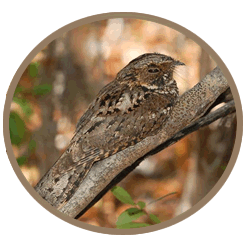
Nightjars have some of the best camouflage in the bird world! Their feathers are a mix of brown, gray, black, and tan in patterns that look exactly like tree bark or dead leaves. When a nightjar sits on the ground or along a tree branch, it's nearly invisible. You could walk right past one and never know it was there. Their flat heads and wide mouths give them a frog-like appearance!
A nightjar's mouth is amazing! When closed, their tiny beak looks very small. But when they open wide, their mouth stretches nearly the full width of their head. Stiff feathers called rictal bristles surround the mouth like a funnel. This enormous gape acts like a flying insect net. Nightjars scoop up moths, beetles, and other insects right out of the air!
Nightjars have huge eyes designed for seeing in the dark! Their large, dark eyes reflect light, sometimes glowing red or orange in flashlight beams. They have excellent night vision for hunting flying insects at dusk and dawn. Their wings are long and pointed for agile, silent flight. Nightjars also have tiny feet because they spend almost no time walking!
Where Do Nightjars Live?
Nightjars live on every continent except Antarctica! There are about 97 species found worldwide. Whip-poor-wills live in forests across eastern North America. Common nighthawks are found across most of North and South America. European nightjars breed in open woodlands from Britain to Central Asia. Many tropical nightjars live in South America, Africa, and Southeast Asia!
Nightjars prefer open areas with plenty of insects! They hunt over forest clearings, meadows, wetlands, and even city streets. Common nighthawks often live in cities, nesting on flat gravel rooftops. They can be seen swooping after insects around streetlights at dusk. During the day, nightjars rest on the ground, on tree branches, or on flat rooftops where their camouflage keeps them hidden!
Many nightjars are long-distance migrants! Common nighthawks travel from Canada all the way to South America each fall. European nightjars winter in Africa south of the Sahara. These nighttime travelers often migrate at night, which makes their journeys hard to study. The common poorwill of western North America does something even more amazing-it hibernates! It's the only bird known to truly hibernate through winter!
What Do Nightjars Eat?
Nightjars eat flying insects caught on the wing! Moths are their favorite food, especially large moths attracted to moonlight and artificial lights. They also eat beetles, mosquitoes, crickets, flying ants, and mayflies. Nightjars catch their meals in midair using their enormous, gaping mouths. A single nightjar can eat hundreds of insects in one night!
Nightjars are aerial acrobats! They fly with quick, twisting turns to chase insects through the air. Their long wings let them change direction instantly. Some nightjars hover briefly before snatching a moth. Common nighthawks make steep, buzzing dives while hunting-you can hear the wind through their feathers as they pull up. Nightjars even drink water on the wing, skimming the surface of ponds!
The timing of nightjar hunting matches insect activity! They're most active at dusk and dawn when many insects are flying. On moonlit nights, they hunt for longer hours. Some species are attracted to campfires and streetlights because the light draws insects. Nightjars help control insect populations naturally. A family of nightjars can eat thousands of mosquitoes and crop-damaging moths!
Baby Nightjar Facts
Nightjars don't build nests at all! They lay their eggs directly on the ground, on leaf litter, or on flat surfaces like rocks or gravel roofs. Most species lay just 1 to 2 eggs. The eggs are beautifully camouflaged with speckled patterns that blend into the ground. Without a nest to give them away, the eggs are very hard for predators to find!
Both parents take turns sitting on the eggs! The mother usually sits during the day, when her excellent camouflage keeps the eggs hidden. The father may take over at dusk or dawn. The eggs hatch in about 16 to 21 days. If a predator comes too close, the parent may flutter away, pretending to be injured to lure the danger away from the eggs!
Baby nightjars are covered in soft, fluffy down! The chicks are well-camouflaged from birth with mottled brown and gray patterns. They can move around on the ground within a day or two. Both parents feed the chicks by pushing insects into their wide little mouths. Baby nightjars grow quickly on their protein-rich insect diet!
Young nightjars can fly at about 20 to 25 days old! They continue to beg for food from their parents for a few more weeks. By late summer, young nightjars must be strong enough to migrate thousands of miles. First-year birds make this incredible journey on their own. They return to breed at about one year old!
Why Are Nightjars Special?
Nightjars are some of the most mysterious birds in the world! Most people have never seen one because they're active only at night and nearly invisible during the day. Yet they live all around us, eating thousands of pest insects every night. Nightjars are the hidden heroes of insect control!
Nightjars have some of the most incredible adaptations in the bird world! A bird that can hibernate, another that can call its own name over 1,000 times nonstop, and all of them with mouths that stretch wider than their heads. These unique features make nightjars unlike any other group of birds!
Many nightjar species are declining and need protection! Light pollution affects their hunting by confusing insects. Habitat loss reduces nesting areas. Pesticides kill the insects they depend on. Some species like the whip-poor-will have become much harder to hear on summer nights. Protecting dark, natural areas helps nightjars thrive!
Nightjars remind us that amazing wildlife is active while we sleep! The night world is full of incredible animals that most people never see. Next time you hear a strange bird call after dark, or see a bird swooping near a streetlight at dusk, you might be watching a nightjar on its nightly insect patrol!