What Do Swifts Look Like?
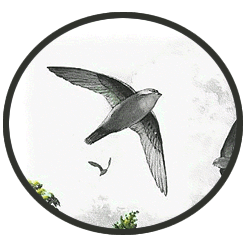
Swifts are built for speed! They have long, narrow, curved wings shaped like boomerangs. Their bodies are compact and streamlined, with short necks and flat heads. Most swifts are dark brown or black with pale throats or bellies. Chimney swifts look like "flying cigars" because of their tubby body shape. When they fly overhead, their silhouette is easy to recognize!
A swift's wings are longer than its body! This gives them incredible flying ability. Their wing shape lets them glide, soar, dive, and twist through the air with ease. Swifts have very short legs and tiny feet-so small that the scientific family name Apodidae means "footless!" They can't walk or hop like other birds. If a swift lands on flat ground, it may struggle to take off again!
Swifts have wide, flat mouths similar to nightjars! When flying, they open their mouths wide to scoop up insects from the air. Their eyes are set deep in their skulls and protected by special feathers. This helps shield their eyes from flying insects and debris at high speeds. Everything about a swift's body is shaped by its life in the air!
Where Do Swifts Live?
Swifts are found on every continent except Antarctica! Common swifts breed across Europe and Asia and winter in Africa. Chimney swifts live across eastern North America. White-rumped swifts live in Africa. Alpine swifts are found in southern Europe, Africa, and Asia. Vaux's swifts live along the Pacific coast. Since swifts are almost always flying, they live wherever insects fly!
Many swifts have moved into cities and towns! Chimney swifts once nested inside hollow trees. Now they mostly nest inside chimneys, air shafts, and barns. Common swifts nest under roof tiles and in cracks in old buildings. Some swifts in Southeast Asia nest inside dark caves. As older buildings are torn down or renovated, swifts lose important nesting spots!
Swifts are amazing migrators! Common swifts fly from Europe to Africa and back each year-a round trip of over 14,000 miles. They spend only about 3 months at their breeding grounds. The rest of the year, they're flying over Africa. Alpine swifts have been tracked flying nonstop for over 200 days! Young swifts that leave the nest may not land again for two to three years!
What Do Swifts Eat?
Swifts eat insects and tiny spiders caught in midair! They fly with their mouths open, scooping up whatever is floating in the air. Gnats, flies, mosquitoes, flying ants, small beetles, and airborne spiderlings are all on the menu. Swifts can catch thousands of insects in a single day. A family of swifts raising chicks may catch over 100,000 insects per day!
Swifts follow the insects wherever they go! On warm days, insects fly higher, and swifts soar high in the sky. On cool, damp days, insects stay low, and swifts skim just above the ground or water. Before storms, swifts may fly around the edges of weather systems. They can cover huge distances in a day just following swarms of insects!
Swifts collect insects into a food ball for their chicks! The parent catches hundreds of tiny insects, mixing them with sticky saliva in its throat. This creates a ball of food called a bolus. The parent flies back to the nest and feeds the entire ball to a hungry chick. Each bolus may contain 300 to 500 tiny insects packed together!
Baby Swift Facts
Swifts build small cup-shaped nests glued to vertical surfaces! They use twigs, feathers, and plant material caught in midair, all glued together with their sticky saliva. Chimney swifts attach their nests to the inside walls of chimneys. Common swifts nest under roof tiles in old buildings. The nest is the only place adult swifts ever land during breeding season!
Mother swifts lay 2 to 3 white eggs! Both parents take turns keeping the eggs warm. If cold weather reduces the insect supply, the parents spend more time away hunting. The eggs can survive brief cooling periods. Incubation takes about 19 to 21 days. Both parents share all the nest duties equally!
Baby swifts are born naked and helpless! Their eyes are closed, and they depend entirely on their parents for food and warmth. Both parents bring insect food balls to the nest. The chicks grow slowly compared to other birds because their food supply depends on weather. During cold, rainy spells when insects aren't flying, chicks can lower their body temperature and go into a mini-hibernation to save energy!
Young swifts make their first flight at about 6 to 8 weeks old! Unlike most birds, there's no gradual learning. A young swift's first flight takes it directly into its aerial life. Once it leaves the nest, it may not land again for two to three years! The young swift must immediately be able to catch insects, avoid predators, navigate migration routes, and sleep on the wing!
Why Are Swifts Special?
Swifts are the ultimate flying machines of the bird world! No other bird spends as much time in the air. Flying nonstop for months, sleeping while soaring, eating on the wing-swifts have taken the ability to fly further than any other bird. They represent the most extreme adaptation to aerial life!
Swifts provide amazing insect control! A single swift can eat thousands of mosquitoes, gnats, and pest insects every day. A colony of chimney swifts nesting in one chimney can eat millions of insects each summer. Swifts are natural, free pest control for farms, gardens, and cities!
Many swift populations are declining and need help! Old buildings with chimneys and roof gaps are being replaced by modern sealed buildings. Swifts lose nesting sites every year. Insect populations are also dropping in many areas. Conservation groups install special swift nest boxes and protect old buildings where swifts nest!
Swifts show us how incredible flight can be! A bird that lives almost its entire life airborne seems impossible, yet swifts do it every day. Their story inspires engineers, scientists, and anyone who has ever watched a bird and wondered what it would be like to fly. Swifts prove that the sky truly is the limit!