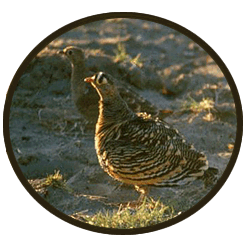
What Do Sandgrouse Look Like?
Sandgrouse are plump, pigeon-sized birds with small heads and pointed tails! Males are often beautifully patterned with bands of gold, chestnut, white, and black. Females are duller with mottled brown and tan feathers that provide excellent camouflage against the desert floor. Their compact bodies and short legs give them a low, ground-hugging look. Most species have long, pointed tail feathers!
Sandgrouse have special feathers unlike any other bird! Their belly feathers have a unique structure that can absorb and hold water like a sponge. The feather barbules are specially coiled to trap water between them. A male sandgrouse can soak up enough water in his belly feathers to carry a tablespoon or more of water back to his chicks. No other bird has feathers designed for carrying water!
Sandgrouse have feathered legs and toes! Unlike most birds, their legs are covered in feathers all the way down to their toes. This feathering protects them from the hot desert sand, which can reach temperatures over 150 degrees. Their short, sturdy legs are designed for walking on the ground. Sandgrouse spend most of their time on foot, only flying to visit water holes!
Where Do Sandgrouse Live?
Sandgrouse live in the driest habitats on Earth! They're found across the deserts and semi-arid regions of Africa, the Middle East, Central Asia, and India. The Namaqua sandgrouse lives in the deserts of southern Africa. Pallas's sandgrouse lives on the cold, dry steppes of Central Asia. Pin-tailed sandgrouse are found from North Africa to Pakistan!
Sandgrouse thrive in places most birds avoid! They live in scorching deserts, rocky wastelands, dry savannas, and barren steppe grasslands. They don't need trees-just open ground with scattered seeds and access to water within flying distance. Some sandgrouse nest miles from the nearest water source. They can survive in areas that seem completely lifeless!
Water holes are the center of sandgrouse life! Every day, flocks of sandgrouse fly to water holes to drink. They may fly 20 to 40 miles each way! The flights happen like clockwork, usually in the early morning. Thousands of sandgrouse may gather at a single water source. These daily water flights are one of the most spectacular bird gatherings in desert regions!
What Do Sandgrouse Eat?
Sandgrouse eat mainly seeds and small plant parts! They walk across the desert floor, pecking at tiny seeds scattered in the sand and gravel. Some species also eat small shoots, leaves, and flowers. Seeds from desert grasses and herbs are their staple food. They need very little food compared to their body size because seeds are packed with energy!
Sandgrouse are very selective seed eaters! They can pick up tiny seeds that other birds would miss. Their short, sturdy bills are designed for cracking and eating small, hard seeds. They often feed in large flocks that spread across the desert like a moving carpet. After feeding, the flock rests during the hottest part of the day, crouching flat on the ground!
Sandgrouse need to drink water every day! This is unusual for desert birds-many desert species get all their water from food. But because sandgrouse eat dry seeds, they must visit water regularly. They drink quickly, filling up in just seconds. Adults can go a day without water in cool weather, but chicks need water daily. That's where the amazing water-carrying trick comes in!
Baby Sandgrouse Facts
Sandgrouse nest right on the bare ground! There's no nest to speak of-just a shallow scrape in the sand or gravel. The female lays 2 to 3 eggs that are perfectly camouflaged to look like small stones. The nest is usually far from water, in open desert terrain. The eggs blend in so well that finding a sandgrouse nest is extremely difficult!
Both parents take turns sitting on the eggs! The female usually sits during the day, when her superior camouflage hides her best. The male often takes the night shift. The eggs hatch in about 21 to 25 days. During incubation, the sitting bird stays absolutely still, trusting its camouflage to avoid detection. Even if a predator walks nearby, the parent may not move!
Baby sandgrouse are active from the moment they hatch! Chicks are covered in spotted down that matches the desert ground. They can walk and follow their parents within hours. Baby sandgrouse start pecking at seeds immediately, but they can't fly to water on their own. That's why the father's water-carrying feathers are so important-without them, the chicks would die of thirst!
Father sandgrouse carry water to their chicks every day for weeks! Each morning, the father flies to a water hole, soaks his belly feathers, and flies back. The chicks cluster around him and drink from his wet feathers. This continues until the chicks are old enough to fly to water themselves, at about 4 to 5 weeks old. Sandgrouse dads truly are super dads!
Why Are Sandgrouse Special?
Sandgrouse have one of the most amazing adaptations in the entire animal kingdom! No other bird has feathers designed to absorb and transport water. This incredible feature allows sandgrouse to raise their families in places where no other bird could survive. It's a perfect example of how animals are designed with exactly what they need!
Sandgrouse show us that life thrives even in the harshest places! They prove that with the right adaptations, animals can survive in scorching deserts with almost no water. Their daily water flights connect distant parts of the desert ecosystem. Sandgrouse are a key food source for desert predators like falcons and jackals!
Some sandgrouse populations face threats from habitat changes! Overgrazing by livestock can reduce the seed supply. Water sources are sometimes diverted for human use. In some areas, sandgrouse are hunted at water holes. Protecting desert water sources and maintaining healthy grasslands helps sandgrouse populations stay strong!
Sandgrouse remind us that nature's designs are endlessly creative! A bird that carries water in its feathers across miles of desert to keep its babies alive-that's a solution no engineer would have thought of! These humble desert birds are one of nature's most ingenious creations!